
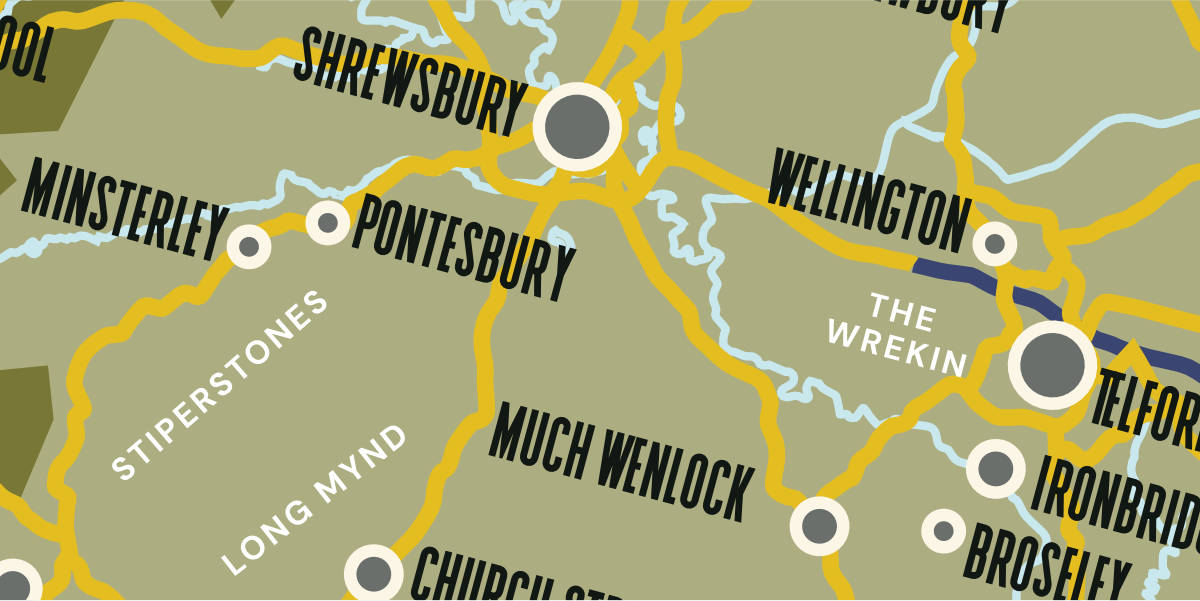


An easy 3.5 mile circular walk through the town of Much Wenlock, along a stretch of the old railway line and out to the disused Farley Quarry, then back to the town.
1914 the railway played a vital role in Much Wenlock’s economy. Not only did it carry passengers but it moved animals to market, limestone to the furnaces, soldiers to the front and then brought wounded men back to the military hospital. But already life was changing. Most stone quarries had closed as demand for fluxing stone for the local iron industry dwindled. The requirement for men and horses at the front virtually finished off an already ailing limestone industry. Although a few of the larger quarries did reopen after World War I, their heyday had passed.
Near the start of the walk is where the railway to Craven Arms left Much Wenlock, and the right hand abutment has long since been demolished to allow the widening of the main road. The line from Much Wenlock to Craven Arms opened in 1867, and connected the town with the extensive quarry workings at Presthope, which had their own sidings.
Shadwell Quarry
Shadwell Quarry which was active in 1914, and had its own railway siding. Wenlock limestone was extracted mainly for use in the iron smelting furnaces in Coalbrookdale, Horsehay, Lightmoor, Madeley Wood and the Black Country. Shadwell Quarry was owned in 1914 by the South Wales and Cannock Chase Coal and Coke Company who supplied fluxing stone to the Madeley Wood Ironworks, but already the market for stone was falling away and the quarry soon closed down. It did reopen later, but finally closed in the mid 1980s.
Tomlins (or Tomlinson’s) Hills Quarry
This quarry opened in 1745. It never had a rail connection, but the path that you follow is on the line of an old tramway or plateway built in 1827 to take stone away. The quarry was abandoned in 1900.
Farley (formerly Gleedon) Quarry
First records of quarrying here go back to 1728. A gravity tramway existed in 1824 to carry the stone to Buildwas, but prior to that stone was carted to the furnaces in Horsehay. The quarry closed in 1901, but was temporarily reopened in 1937 and 1947.
Lady Forester Hospital
Lady Forester Hospital received its first patients in 1903. Matron Smith was in charge in 1914. She had ten female staff, and 43 beds were made available for military patients, many of whom were brought in to Wenlock by train. During WWI 963 patients were treated here, and an illuminated certificate hangs inside the hospital to acknowledge this.