Places of interest:
Oswestry
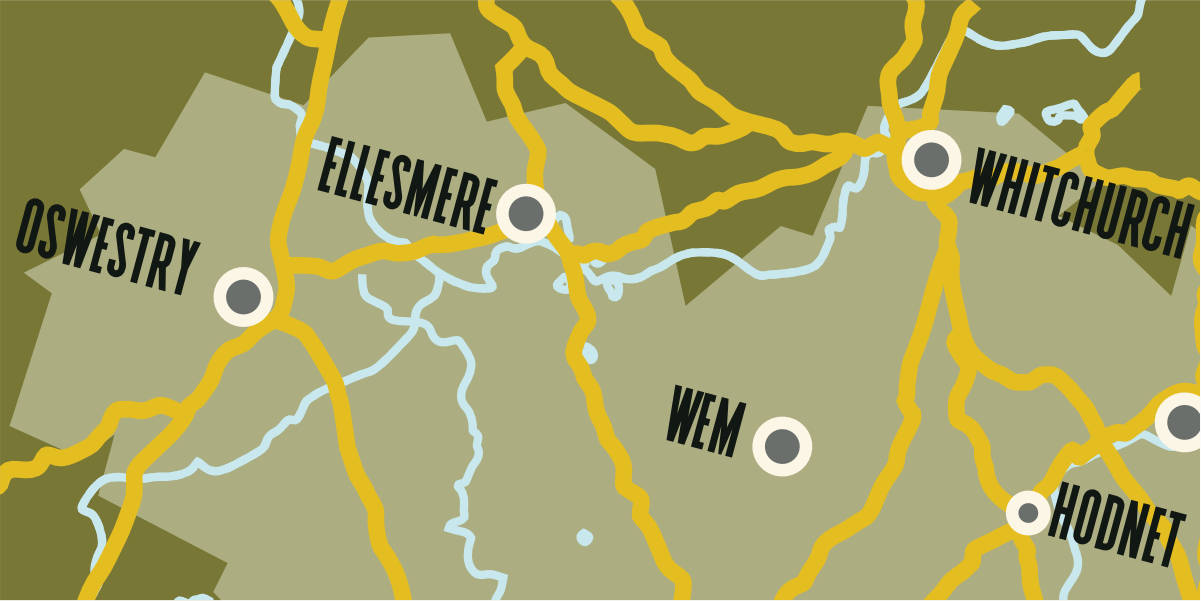
Oswestry is an ancient market town located on the English/Welsh border, nestled in the foothills of the Welsh hills. Its position as a frontier town has given it a turbulent history.
This history is still visible in the encircling English and Welsh town walls and the foundations of the castle, which date back to 1086 and the town’s market which dates from 1190. The name ‘Oswestry’ is thought to be a corruption of ‘Oswald’s Tree’ or ‘Oswald’s Cross’, after the king of Northumberland who was killed in battle by the king of Mercia near Oswestry in 641AD. Most of the town centre is a designated conservation area.
There are lots of historically interesting buildings including the timber framed Llwyd Mansion, the Cambrian railway museum and St Oswald’s Church. Oswestry’s first school founded in 1407 is now the heritage and visitor information centre. The cycle routes in this leaflet start here.
There is a wide choice of places to eat, drink and stay as well as some great shops. The Cae Glas Park is beautiful to walk through when the flowers are in bloom.
Llansanffraid-ym-Mechain
Llansanffraid-ym-Mechain is a bustling village in Wales, probably best known for its football team (TNS), which now plays its games in Oswestry. There are a number of options for places to stop for refreshments and the pleasant church of St Ffraid which dates from the 12th Century. Nearby, on the banks of the River Vyrnwy, is Plas yn Dinas, defensive earthworks possibly dating from the dark ages.
Melverley Church.
It’s worth the time to stop by St Peter’s Church on the banks of the River Vyrnwy. It’s an exquisite black and white timber framed church built in 1406 shortly after the Welsh chieftain Owain Glyndwr burnt down the earlier wooden chapel.