

Shropshire's Great Outdoors

Whixall Walks – 6. Whixall Parish Walk

A 3.5 mile circular route around Whixall parish using canal towpaths, lanes and field paths.

Whixall

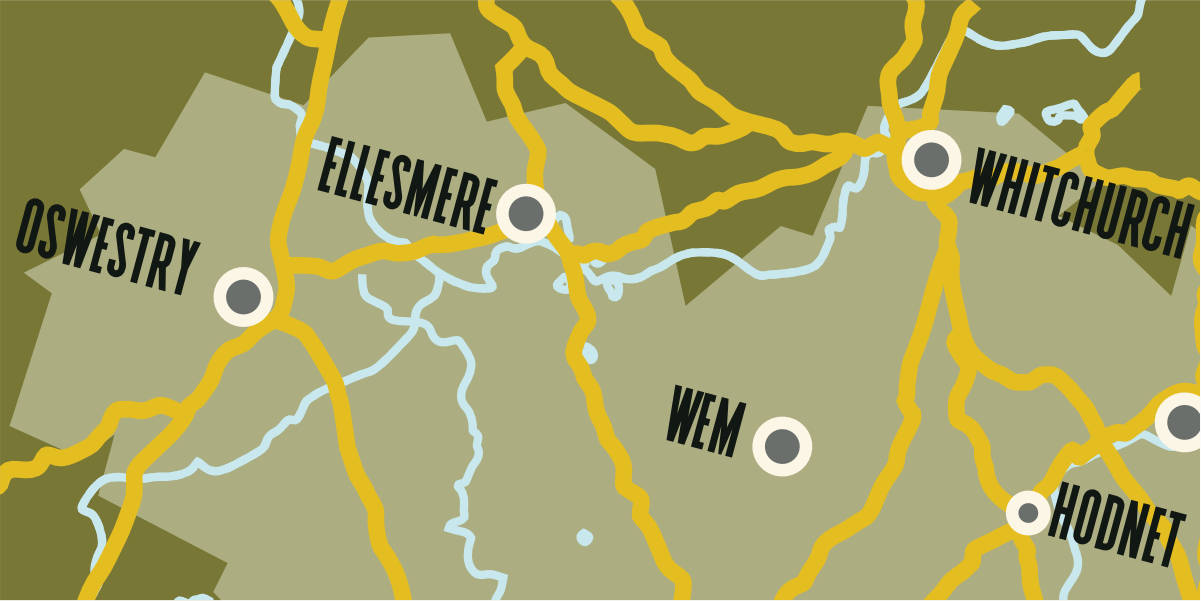
Whixall is the third largest inland village in England, civil parish in Shropshire, England, which is documented in the Domesday Book as having been in existence in 1086.  Within the parish boundaries are a number of hamlets – Hollinwood, Abbey Green, Welsh End, Stanley Green, Dobson’s Bridge, Far End.  The nearest towns are Whitchurch, to the north, and Wem, to the south.

The parish lies on the border with the county borough of Wrexham, Wales. Its close proximity to Wales is shown by a hamlet called Welsh End.

Within the parish boundaries (encompassing seven square miles) are various hamlets including Abbey Green. The Llangollen Canal of the Shropshire Union Canal and the short Prees Branch of the Ellesmere Canal run through the parish.

Ellesmere Canal

The Ellesmere Canal was a waterway in England and Wales that was planned to carry boat traffic between the rivers Mersey and Severn. The proposal would create a link between the Port of Liverpool and the mineral industries in north east Wales and the manufacturing centres in the West Midlands. However, the canal was never completed as intended because of its rising costs and failure to generate the expected commercial traffic.  The stretch of the canal used for this route was built by William Jessop and Thomas Telford between 1797 and 1804 and became part of the Shropshire Union in 1846.

Fenn’s, Whixall and Bettisfield Mosses National Nature Reserve

Fenn’s, Whixall and Bettisfield Mosses National Nature Reserve is a national nature reserve (NNR) which straddles the border between England and Wales, near Whixall and Ellesmere in Shropshire, England and Bettisfield in Wrexham County Borough, Wales. It comprises three peat bogs, Bettisfield Moss, Fenn’s Moss and Whixall Moss. With Wem Moss and Cadney Moss, they are collectively a Site of Special Scientific Interest called The Fenn’s, Whixall, Bettisfield, Wem & Cadney Moss Complex and form Britain’s third-largest lowland raised bog, covering 2,388 acres (966 ha). The reserve is part of the Midland Meres and Mosses, an Important Plant Area which was declared a Wetland of International Importance under the Ramsar Convention in 1997. It is also a European Special Area of Conservation.


Walk directions

  1. Start

    From Platt Lane canal bridge walk up Canalside (with the canal on your right) following the tarmac lane to the next bridge which is Roundthorn Bridge. You are on a stretch of the Shropshire Union Canal (formerly the Ellesmere Canal) built between 1797 and 1804 which at one time was used to transport peat from the Mosses. Cross over Roundthorn Bridge (no 44) and turn left to walk along the towpath.

  2. Step 2

    At Morris Bridge (no 45) take time to look at the information board about the local flora and fauna. Go over the bridge and walk along Moss Lane.

  3. Step 3

    Turn left at the T-junction and carry on along the road until the school zone sign. Just after this there is a stile on your left. Follow the Shropshire Way signs across the fields until you reach the canal and Roundthorn Bridge again. Cross the bridge once more and this time turn right to take the track along the canal.

  4. Step 4

    Continue along the track with the canal on your right. As it bends to the left, carry straight on to the towpath by three small horse chestnut trees. Continue for a short distance until you are back where you started.

Whixall Walks - 6. Whixall Parish Walk

PDF information may be outdated

This route leaflet may not include recent changes. Some pubs or cafes listed might have altered or closed. For the latest route details, please consult this webpage.

13 Whixall Walks

PDF information may be outdated

This route leaflet may not include recent changes. Some pubs or cafes listed might have altered or closed. For the latest route details, please consult this webpage.

Other nearby walks

Privacy & cookie settings

This website uses cookies so that we can provide you with the best user experience possible. Cookie information is stored in your browser and performs functions such as recognising you when you return to our website and helping our team to understand which sections of the website you find most interesting and useful.

For more information, please view our privacy notice

You can adjust your cookie settings by navigating the tabs here. You can return to this menu to adjust your options in future by clicking the cookie settings icon that appears towards the bottom of the page when viewing our site.

Strictly Necessary Cookies

Some strictly necessary cookies are required for our site to function, and therefore can not be disabled.

Additionally we use a GDPR compliance cookie to remember the preferences you set here. You can disable this cookie below, however you will be asked to set your cookie preferences every time you visit a page on this site.

Third-party services

This website uses Google Analytics to collect anonymous information such as the number of visitors to the site, and the most popular pages.

Keeping this cookie enabled helps us to improve our website.